
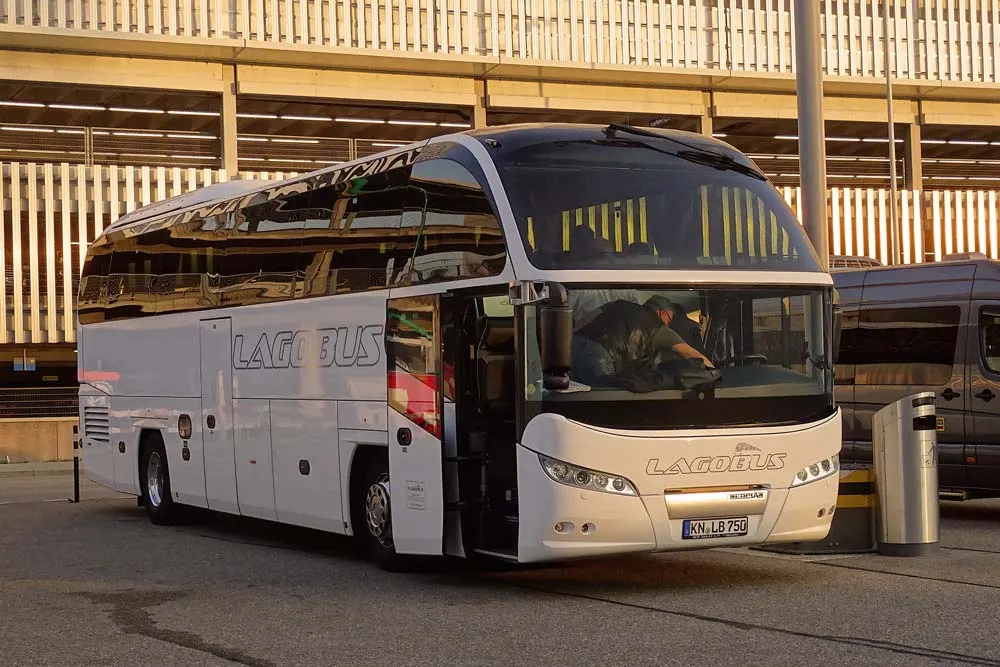
Touring and transfers in Switzerland
Not an EU member, its own charging logic, demanding topography: Switzerland needs more lead time than any other leg in the German-speaking region.
Request a tourFor tours and transfers in Switzerland a coach above 3.5 tonnes maximum permissible laden mass pays the flat-rate heavy vehicle charge, PSVA, not the motorway vignette. Vehicles registered abroad settle the charge through the Via portal of the Federal Office for Customs and Border Security.
Switzerland is not an EU member state. Instruments, backline and equipment must be cleared on entry, typically under temporary admission with an ATA carnet. That lead time belongs in tour planning, not in the week before departure.
Last updated 18/09/2026. All country pages
PSVA: the charge for coaches instead of a vignette
Motor vehicles for passenger transport with a permissible total weight above 3.5 tonnes are subject to the flat-rate heavy vehicle charge in Switzerland. For vehicles registered abroad the PSVA is settled through the Via portal of the Federal Office for Customs and Border Security; since the start of 2025 that route runs online for foreign vehicles. Source: BAZG, flat-rate heavy vehicle charge for vehicles registered abroad.
The charge is paid per vehicle and period. For a tour with several Swiss performance days and several vehicles it therefore matters early which vehicle stays in the country for how long. We handle that disposition.
Customs and instruments: entering a non-EU country
Because Switzerland is outside the EU customs territory, instruments, backline and equipment are cleared on entry. The usual route is the ATA carnet for temporary admission: a customs document listing the items with description, serial number and value, covering import and re-export.
The application sits with the promoter, the agency or the ensemble, usually through the responsible chamber of commerce. We flag it early, build border time into the schedule and coordinate customs and document questions with your production management.
In practice the instrument list must be final before the tour and must not grow along the way. An instrument missing from the carnet becomes a problem at the border, not in the hall.
Driving and rest times, and driver planning
For companies based in the EU the European social rules apply across the whole journey; as a contracting party to the AETR, Switzerland applies materially equivalent rules. So the schedule is built on the same principles as on EU legs.
Swiss legs are shorter in kilometres and longer in hours. Passes, tunnels, roadworks and the traffic before the alpine tunnels move arrival times. We calculate with realistic driving times rather than map values and put buffers before sound checks.
Venues, alpine legs and winter
The main venues are Zurich, Geneva, Basel, Bern, Lucerne, Lausanne, St. Gallen and Lugano. The north-south axis runs via the Gotthard or San Bernardino, the west-east axis along the Mittelland; the route into Ticino is the most demanding, depending on weather and traffic.
In the winter half of the year, winter tyres, snow chains on board and a driver with mountain experience are standard, not an extra. For tours between November and March we plan alternative routes alongside.
Coach standing space is scarce in city centres. Access, standing position and waiting area are agreed with the venue or promoter before the tour.
How we work together
Send us the draft tour plan with venues, headcount and instrumentation. We check legs, charges and customs lead time, propose vehicles and driver staffing and reply with an indicative quote within 24 hours.
Agencies and productions with recurring Swiss dates get fixed conditions and committed availability through the partner programme.
Frequently asked questions about touring in Switzerland
Does a coach need a motorway vignette in Switzerland?
No. Motor vehicles for passenger transport above 3.5 tonnes permissible total weight are subject to the flat-rate heavy vehicle charge (PSVA). Vehicles registered abroad settle it through the Via portal of the Federal Office for Customs and Border Security. Source: BAZG.
Do we need an ATA carnet for instruments entering Switzerland?
As a rule yes. Switzerland is outside the EU customs territory, so instruments and equipment are cleared on entry. The ATA carnet covers temporary admission. It is applied for by the promoter, agency or ensemble, usually through the responsible chamber of commerce; we flag it early and build border time into the schedule.
How much lead time does a Swiss leg need?
More than an EU leg. Charges, customs documents and the instrument list must be settled before departure. For tours with Swiss performance days we recommend settling ground mobility at the latest together with the hotel booking.
Are alpine legs workable in winter?
Yes, with preparation. Winter tyres, snow chains on board, drivers with mountain experience and checked alternative routes are standard between November and March. We calculate with realistic driving times rather than map values and put buffers before sound checks.
Who drives, a Swiss or a German partner?
The tour decides that, not the border. We deploy the vehicle that fits the line-up, the instrumentation and the sequence of legs, and either way we remain your single contact and contracting party.
Do you also arrange single transfers in Switzerland?
Yes. Airport, hotel and venue transfers, festival shuttles and runs to TV and promo appointments are booked individually by agencies and productions.
Sources
- Federal Office for Customs and Border Security (BAZG), flat-rate heavy vehicle charge (PSVA) for vehicles registered abroad, retrieved 18 September 2026
- Regulation (EC) No 561/2006 as amended by Regulation (EU) 2024/1258; European Agreement concerning the Work of Crews of Vehicles engaged in International Road Transport (AETR)
Talk to us
We are happy to advise you on your upcoming tours and put together a tailored tour plan with suitable transport.
Request a tour